Dear Prime Minister Wong,
We write as residents of Sunset Way concerned about the future of Maju Forest, and we are writing to submit our alternative proposal for climate-positive development that would put Singapore’s City in Nature vision into practice. Our concerns span Singapore’s biodiversity and heritage, the shared and pressing challenge of rising urban temperatures under climate change, rising electricity and medical bills, and the shrinking availability of wild natural spaces in land-scarce Singapore. We are copying Mr Menon here, given his mandate in overseeing Singapore’s climate resilience and international climate commitments.
Over the past few weeks, residents have been proposing alternatives and engaging constructively with government agencies. We presented a letter to MP Christopher de Souza, signed by 716 residents and families as of early September 2026, and have set out our position more fully in our Community Declaration, grounded in the principles of Avoid, Include, and Demonstrate before any development proceeds. Both documents are attached.
We were heartened by Minister of State Alvin Tan’s announcement on 14 August that more greenery will now be retained at both Maju Forest and Gillman Barracks, and by the precedent this recalls: in 2021, plans for Dover Forest were similarly revised after public feedback and further scientific study. We believe Maju Forest offers the government a further, even more compelling opportunity to build on that same instinct.
We are not against development, or against housing. Many residents in Sunset Way who care about the forest live in HDB flats themselves, and are grateful for such a bold nationwide programme. But Singapore’s continued growth and its climate commitments need not compete. The Government has already committed more than $100 billion over the coming decades to coastal protection alone, and a further $40 million for heat research under the Heat Resilience Policy Office. We believe Maju Forest can contribute directly to these efforts at minimal additional cost by putting a mature ecosystem that is already doing this work to formal, permanent use.
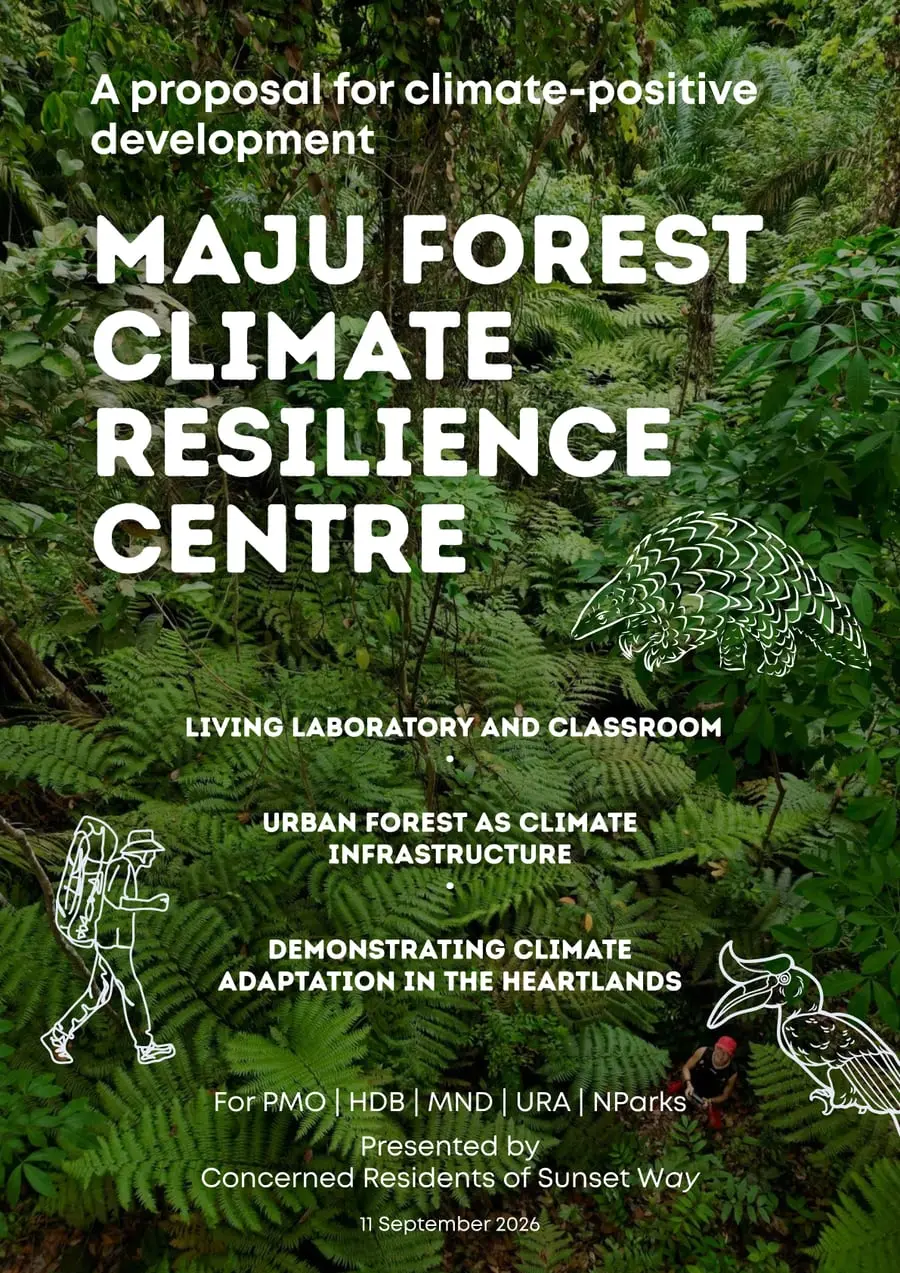
Our proposal: Maju Forest Climate Resilience Centre
A living laboratory and classroom: We propose that Maju Forest be retained in full and developed instead as a mixed-use Maju Forest Climate Resilience Centre, doubling as a research centre and a recreational space. At its present size, Maju Forest could serve as a model site for urban forest research, placing Singapore at the global frontier of research on urban cooling, biodiversity, nature-based climate infrastructure, and human-wildlife interaction. A study of Tengah, Singapore’s most recent case of large-scale secondary forest clearance, found an average 5.5°C rise in surface temperature where forest gave way to housing. Research at Maju Forest could tell a different story: what an urban forest, left standing, can do for Singapore’s climate resilience. The forest could further serve as an educational space on biodiversity and climate resilience for Singapore’s schools, while vacant shopfronts in the surrounding HDB estate could be repurposed as learning galleries, laboratories, or classrooms, bringing new life and footfall to the neighbourhood centre.
Urban forest as climate infrastructure: Maju Forest is already climate infrastructure, and has been for decades. The forest buffers against rising urban heat, haze, and flood risk, often more effectively than costly built alternatives such as heat-resistant paint or air-conditioned cooling centres. A Maju Forest Climate Resilience Centre would let Singapore formalise and study this function, in direct support of both the City in Nature vision and the adaptation priorities set out by the National Climate Change Secretariat and MSE.
Demonstrating climate adaptation in the heartlands: MSE recently broke ground on Changing Course, Asia’s first experiential climate adaptation hub, at Sentosa. A Maju Forest Climate Resilience Centre would bring that same vision into Singapore’s heartlands — a place where residents live alongside the adaptation effort daily, rather than visit it. This would also complement the placemaking push that Minister Chee Hong Tat has championed to bring greater vibrancy and footfall to heartland neighbourhoods. A Climate Resilience Centre in Sunset Way would bring placemaking, development, and sustainability into a single vision.
This is not a request for “no development.” It is a different kind of development that could position Singapore as a global leader in climate research, climate infrastructure, and climate adaptation. The centre aligns with existing plans to transform Singapore into a hub for tropical climate resilience research and development, exemplified by the new Heat Resilience Policy Office. The Maju Forest debate has already drawn coverage from Al Jazeera, Bloomberg, Reuters, and the South China Morning Post. A considered, science-led outcome here is a chance for Singapore to show what its City in Nature vision looks like in practice, even on our land-scarce island city.
What we are asking for
As set out in our Community Declaration, we ask that any housing need currently assigned to Maju Forest be redirected to the brownfield sites we understand were already considered and set aside. We would welcome transparency on what these sites are, why they were ruled out, and what timelines and demand projections make Maju Forest necessary rather than merely convenient. As a resident put it during a recent engagement with HDB: the unavailability of a brownfield site today does not, on its own, justify clearing a forest today. Scarcity in one column of the ledger does not license drawing down an irreplaceable asset in another.
We hope residents can be engaged in co-designing plans for Maju Forest, and that our proposal for a Maju Forest Climate Resilience Centre will be given serious consideration. We believe it offers a way to honour both Singaporeans’ desire for biodiversity conservation and the Government’s commitment to sustainable development. These are not presented as competing goals but one plan.
We remain committed to engaging constructively and through proper channels, as we have throughout this process, and would welcome the opportunity to discuss this proposal with your office, and to work through what it would take to make it real.
Yours sincerely,
Concerned Residents of Sunset Way